
The Questions We Don't Ask
Recently, we had a team cultural capacity workshop called "Ask a Māori Anything", facilitated by Tāne. The concept is simple. To create a safe space where people can ask the questions they've always wondered about, but perhaps never felt comfortable asking.
For many of us, there are topics we avoid because we're worried about saying the wrong thing, causing offence, or exposing what we don't know. Yet those unanswered questions can sometimes become barriers to understanding.
During the session, we talked about everything from the haka to identity, whakapapa, language, and cultural practices. Some questions were practical. Some were personal. Some challenged assumptions we didn't even realise we held.
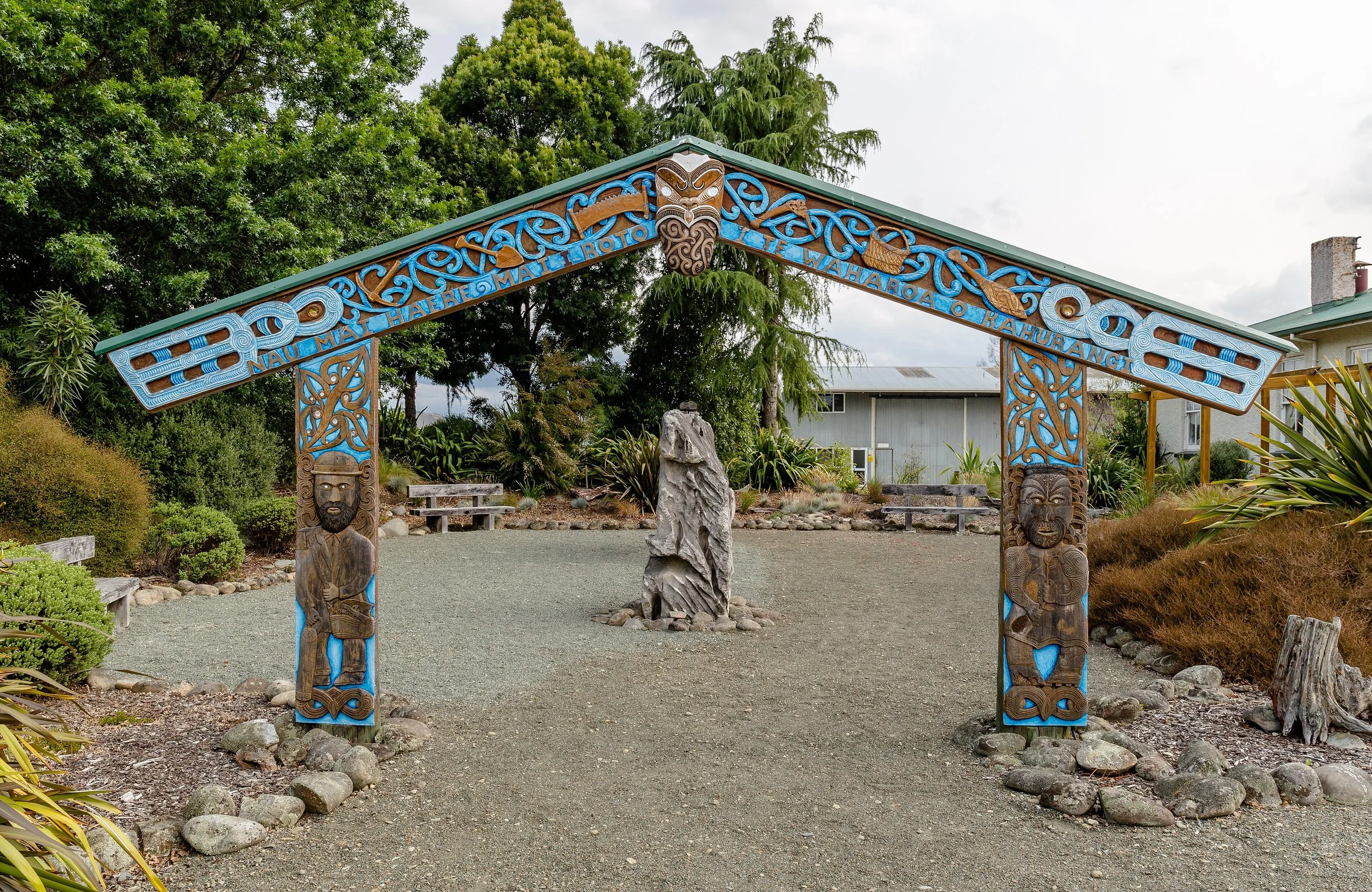
The Gateway to Kahurangi.
One feature of the waharoa describes the maihi as "arms embracing in unity".
Following our conversation with Tāne, we felt this reflected the spirit of the session: creating space for people to come together, ask questions, and better understand one another.
One question that sparked plenty of discussion was about mountains and rivers in terms of your mihi. How do people know which mountain or river they identify with? Is it based on where they were born, where they grew up, their family history, or somewhere they feel particularly connected to?
Rather than giving a simple answer, Tāne helped us explore the deeper idea of connection to place. The discussion encouraged us to think about our own relationships with the landscapes that have shaped us and the places that feel like home. It was a reminder that our stories are often closely tied to the places where we have lived, learned, grown, and built relationships.
What struck us most wasn't any single answer, but it was the environment that Tāne created. There was no judgment. No embarrassment. No expectation that anyone should already know the answers.
Instead, there was an invitation to be curious.
As a community organisation, we often find ourselves working alongside people with different backgrounds, experiences, beliefs, and perspectives. Building strong communities isn't about everyone thinking the same way. It's about being willing to listen, learn, and understand each other a little better.
That starts with conversation.
Sometimes we hear people say they're worried about asking questions because they don't want to get it wrong. Our experience was the opposite. Respectful questions opened the door to meaningful discussions and deeper understanding.
The session was a reminder that curiosity is powerful. When people feel safe to ask questions and share their experiences, connections grow, assumptions are challenged, and relationships become stronger.
We're grateful to Tāne for sharing his time, knowledge, and perspective with our team.
Most of all, we're grateful for the reminder that understanding often begins with a simple question.
If you have a question, chuck it down here. Curiosity must always be encouraged!
Translations
-
Gateway or entranceway, often marking the transition into a significant place.
-
A word with several meanings, including "precious", "treasured", "chiefly", and "blue/colour of the sky". In this context the panel notes "one meaning is colour of the sky".
-
Mountain
-
The bargeboards or outstretched arms of a meeting house. On the gateway they are described as "arms embracing in unity".
-
A traditional Māori weapon and symbol of challenge, leadership and authority.
-
Traditional painted decorative patterns, often representing natural forms, ancestry, rivers, growth and movement.
-
Guardian, protector, or caretaker.
-
Welcome. An invitation to come forward and enter.
-
The Gateway of Kahurangi.
-
The Kahurangi region/area. "Rohe" means district, territory or region.
